
Engineering Euphoria
Why cults and high-control groups are the best places on earth, until they're the worst.

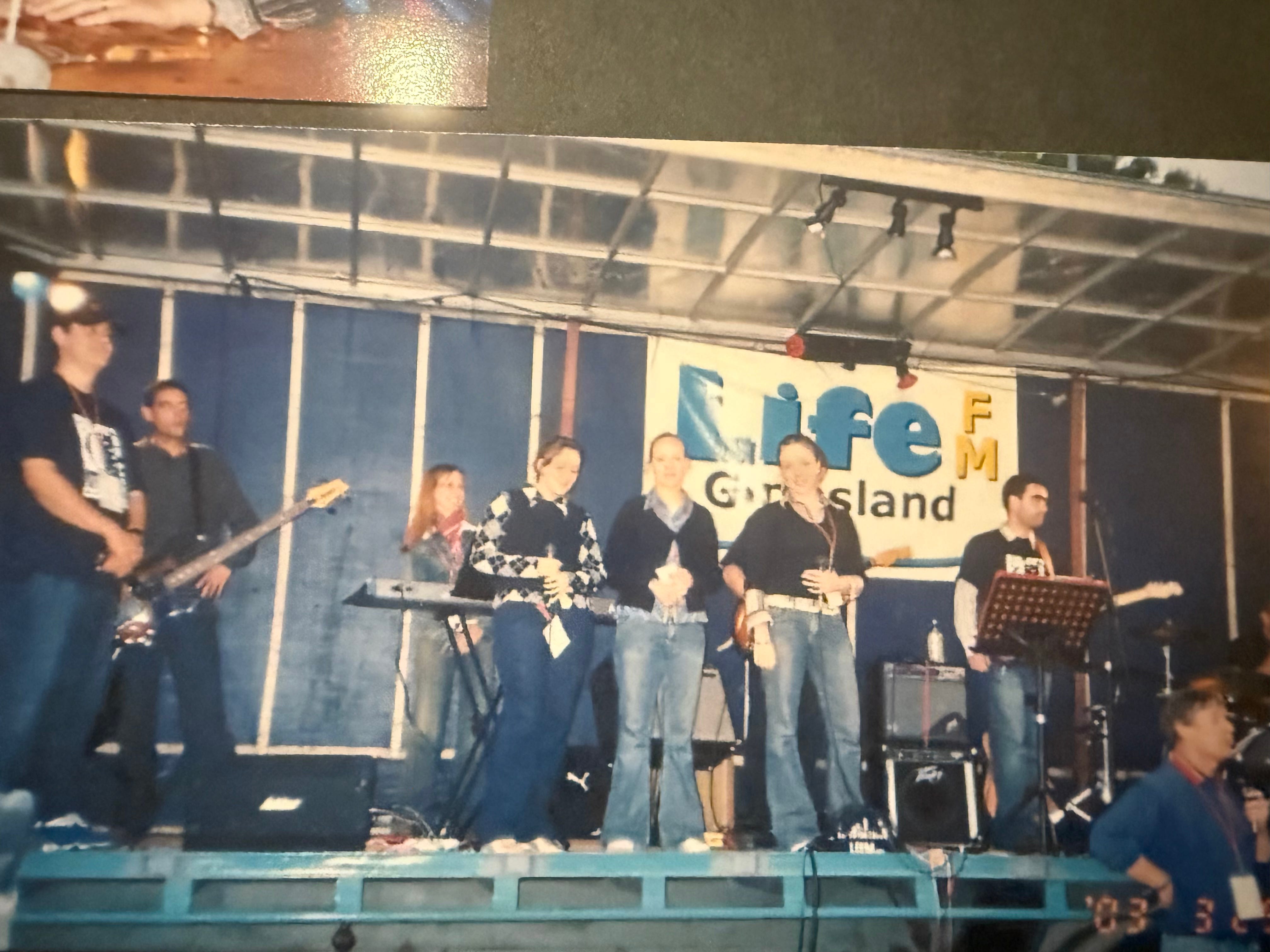
*image from the archives. Circa 2001. Live performance in the back of a truck at the Local Agricultural Show. Faces too blurry to recognise unless you’re in the know
Note: This is a reflective piece and is totally not backed by academic research. The author still firmly believes she’s onto something, though. You be the judge.
They say no one joins a cult on purpose. They join the loveliest group of people they’ve ever met. The most loving. The most utopian. Then gradually, they begin to understand the worldview held by this group. It doesn’t happen all at once. You learn their truth, this transcendant way, piece by piece, with the most palatable parts first. By the time you realise what you’re part of, you’re in so deep that there are very real, very fearsome costs to leaving. Your family might be inside. The cult may have huge chunks of your money, your personal secrets, or your business and career tied up inside. You may be living in shared cult accommodation. You may have been conditioned to see the world outside as dangerous, out to get you, a collection of traps that lie in wait. The list goes on. No one ever joins thinking that is going to happen to them.
The joining starts with engineered euphoria.
This is a hard one for me to reflect on because my father ran the high-control, fundamentalist sect I grew up in. I still struggle to call it a cult, because it contains people I love. But it meets the important definitions. Still, I’d rather call it a sect so I don’t choke on the words.
I didn’t join it. I was raised in it. I never got to experience the love-bombing part of recruitment, and only ever got to witness it and be part of it from the angle of ‘reaching people’ and ‘bringing them in.’
My experience was the prayer lists; that is, the list of names we would bring to Training for Life (Our youth discipleship program) every Friday. It was the strategising about how we could get these ‘soft’ people on our prayer lists along to events where they could meet others from our group, so we might gradually become their best friends and most trusted confidants. It was about how we could get them into Alpha, the first of the short courses that would legitimise us as normal Christians before the heavier stuff came in.
I remember those.
And I remember our house parties. I’ve spoken of our house before as one that was bursting at the seams. A single-bathroom, four-bedroom house with a garage and a study, it was home to an unreasonable number of people. At one point, we had one (functionally two) boarders in the shed, three in the study, two in another of the bedrooms sharing with a Heath kid, and then the remaining four Heath kids and two Heath parents in the remaining three rooms. It was an unremarkable, dusty pink weatherboard home in a street called “Ellen Way”, and the neighbours would muse as to which of the hoards who hung around there were actual Heaths and which ones weren’t. I remember one of my tiny siblings even got it wrong once.
I remember people laughing about it because it was “funny.” I laughed because I had to. But my small sibling, a preschooler, thought my blonde sister was just living with us because she had a bad family, and that a brunette boarder was a legitimate sibling. I laughed, heart sinking to my stomach, eyes darting to see who was looking on and ascertain if they were laughing, too. Our family was dissolving at the edges, and the hangers-on who idolised dad and coveted a place in our family were becoming enmeshed in that blurry edge.
Our house parties are vivid in my memory, and they hit with a particular pang when I leaf through the handmade photo album my mother slaved over as a gift for my 21st birthday. In its pages are all my cringiest moments, some of the happier ones, and moments I view with such mixed feelings. In looking at those photos, I’m hit with memories that sit at a sensory level. The house parties happened in the shed, and I remember the metallic, high-pitched screech as the latch turned on the shed door and opened up. The stale smell of our male boarders’ makeshift bedroom as he panic-cleaned in prep for the parties. The rough wooden bench at the back of the shed that was cleared of jars and cans of salvaged screws and nails to become a makeshift grazing table for the night. The jasmine vine that crept up over the lattice by the veranda.
The noise. The youth group turning up. The neighbours. And somewhere in it, me. Probably in a flannel shirt and two plaits.
The photos show them as fancy dress - quite often “cowboy” themed. There would be no alcohol, no worldly music. We would set up the garage band and jam. A song by Big Tent Revival called “Choose life.” A song by Audio Adrenaline called “DC10”. A collection of others curated for levity and then impact.
We’d invite the neighbours, or the youth group kids, or the prayer list kids. If it wasn’t a house party, it was often taco night. Everyone, come over to the Heath’s for dinner! Invite someone off your prayer list. Or maybe just the ones you feel are ready for Alpha. The noise was raucous. The table was decked out with the taco spread, and there were not enough seats around the table, so we migrated to the lounge room floor. Here, Dad would naturally start conversing with the youth leaders or the ones in training. The room would slowly gravitate toward him, with the new recruits and old alike hanging off every word.
When we did the dishes, we would sing. The Ellen Way House had beautiful acoustics and a large window where we could all see our reflection. So dishes time was singing time. My mother loved the experimental harmonies we busted out there, when the stakes were low. And I did love singing. Singing was my euphoria. One that my dad kept tight control of. “You can’t lead songs”, he told me once. “People get distracted by your voice.” I was sent back to the keyboard. But all I ever really wanted to do was sing.
Back to taco night, though.
I remember once, two new recruits had weed habits they disclosed at one of these informal events. (Although, don’t quote me on it. It could have been a spaghetti night). I remember Dad instructing one of us to “get the oil” and the spirit of addiction was cast out. I was standing by the door when it happened, leaning against the Yamaha Clavinova keyboard placed underneath the window. As the “demon came out,” Dad yelled, “Open the door!”, because the demon had come out with such force that we had to let it out of the house.
Ever obedient, I flung the door open and felt the cool breeze flood in from outside and fill the room with its fresh chill.
I’m pretty sure Robert Jay Lifton would call this mystical manipulation.
Did I feel a demon leave? No? I dunno? What does that even feel like? Did others? The breeze may have helped them ‘bear witness’ to the moment.
Though the lens through which I view these moments is laced with mixed feelings, I do concede that for most people, they were likely quite euphoric. These moments of closeness, acceptance (before the conditions kicked in), freedom (before the rules kicked in), community and the promise of elevated collective purpose. It’s certainly what I heard in their enthusiasm for being part of this group. But this euphoria was engineered. Intentional. And an elixir for the moments when the favour of “God” was switched out for “his discipline.” During the crushing lows of an existential beatdown during one of the many discipleship sessions, leadership meetings, youth meetings and covenant meetings, you might be tempted to run for the hills, but oh the euphoria that would greet you when you got back into “God’s” favour. Or just when the next event came around.
It was probably a coincidence that our hardcore discipleship sessions came right before youth group. The hard word, group shaming and confessions followed closely by sugar highs, music and games.
You cope with the lows better when the highs are so high. All the love. All the connections. All the ‘like-minded people’. Of course, there was a process by which we had all become so “like” of mind. The thick threads of tribe winding closer around a person as friends became family, and the bonds between those who ‘got it’ and their friends and family on the outside who didn’t get it loosened over time. When this group felt so close, so understanding, so generous in their “truth” that they would hold you to a higher standard and push you toward your destiny. They were so chosen by God for a higher purpose, and somehow, you got to be chosen, too! If your family didn’t get it, it only made sense to draw closer, bit by bit, to those who did get it. Your real spiritual family. Your covenant family.
It couldn’t work without engineered euphoria. The intoxication of ‘unconditional’ friendship, of deep listening where you could share your deepest desires, fears and aspirations (albeit in blissful unawareness that these very things could be used against you later). The buzz of music, the hum of chatter and crowds, the drugless, alcohol-less dancing, the group singing, and later on, the altered states of consciousness accessed by prolonged periods of praying in tongues, immersive worship with dancing and prophetic movement, prophetic declaration and indoctrination by exhaustion, and highly engaged preaching where you are drilled on yelling “amen” while taking notes before you even have a chance to stop and think “does this make sense?”
Engineered Euphoria leaves you highly open to suggestion. For us, that suggestion was that we were a chosen generation, we were meant to be a standard in our land. That we were to offer our lives for this cause that was greater than us. That we would bring about the government of God, taking dominion in every domain and through that bring Heaven to Earth.
The engineered euphoria may have looked like shed parties, cowboy themes, taco night and youth group in the beginning. But it wouldn’t be enough to channel someone through to being one of that chosen generation. The euphoria then had to come from belonging, deep sharing, and the idea of an elevated destiny. But there had to be practical aspects to that, too. Missions trips, youth band, singing in front of crowds, going to youth camps and being that group who always clustered around our pastor, hanging off his every word, because we were that chosen generation.
Eventually, it’s not enough. This is where the engineered euphoria takes on a darker edge. (And hey, this is just my reflection and observation, not an academic thesis, as obvious). How do you engineer euphoria when the glamour has worn off that? You engineer a crisis, and then you save the day.
This is where so many cults and high-control groups grieve me. You see testimonies of broken people being healed in these groups, but if you dig a little deeper, you learn that the brokenness often didn’t emerge until after they began going through the group’s thought-reform process. Like there was a ‘prophetic word’ about someone’s rejection wound, and then the claim that God healed them through the sect’s thought-reform program.
Can you take credit for healing someone if you broke them? Or if you deliberately chose people with a wound so you could swoop in with “the answer.”
A classic example is non-acceptance of someone’s sexuality or gender, the erasure of LGBTQIA+ identities and realities, the introduction of conversion practices and then “Bam!” Healed. But before the ‘healing’, the person had to be convinced they were broken. They had to be introduced to self-hatred. And then the group introduces the answer. The answer might damage the person greatly, but not before testimony is used to create an external pressure on the person as they step onto the stage in another moment of engineered euphoria and announce, “I am healed.“
But study after study, survivor testimony after survivor testimony, will tell you they were not healed. They were broken and forced into cosplaying straightness at the cost of their own well-being. The scars are usually devastating and lifelong. (If this is you, hit me up. I know survivor groups. Having people get you really does make this easier. There’s hope). Because guess what. LGTBQIA+ isn’t broken. It isn’t bad. It’s also just one of the things pathologised in cults and high-control groups.
Other things? There are many. But just hope you don’t have to face a trauma in one of these groups. Engineered euphoria is not a case of voluntary participation. Resistance can read like rebellion.
I was broken in my group. Then I was ‘healed’ in it. My testimony was used to enforce compliance with the fruits of this healing. If I fell out of living as if this ‘healing’ was still in effect, I’d be grilled on what secret sin was allowing the enemy back in. The odd thing about testimony culture is that you are blamed for your failures, but God and leader get credit for your successes.
I remember dislocating (shattering) my elbow at age 11. I then had floating bone fragments in my joint for years, and only when I was 19 did I discover my shoulder had been growing out of socket, too. I sometimes turned up to church in a sling. I must have been 12 or 13 the first time an Uncle in the church told me I must have a secret sin because he had prayed, and therefore God must heal me unless I had a secret sin.
Testimony culture is engineered euphoria.
Testimony culture is also forced compliance.
I’ve often spoken about what I goal the peacock and feather-duster cycle. One moment, you are in favour, the next, you are in chaos. When you are in favour, there is a euphoria of being in full alignment with God and leader. You are an example. You are chosen for speaking spots, missions, leadership, stage time, and covenant group. You are in euphoria. But at any moment, you can fall into chaos. You go from being the peacock to the feather duster. It may be that you have fallen into the sin of pride. It may be that someone has raised an issue they have with you, and you have not responded correctly. It may be that you responded correctly, but your body language was off. It may even be a ‘prophetic word’ about what you did wrong. Any number of things can take you from peacock to featherduster, from favour to chaos, from euphoria to yearning to regain it.
Engineered euphoria is like a drug. It’s the dose you need to be lured in, kept in, compliant. Engineered crisis is the alternative that leaves you hungry to taste that euphoria again. Not all cults and high-control groups use illicit drugs (although some do. Ooooft.). But they all use this one. I swear to God, they all use this one.
In the beginning, engineered euphoria is the hook. In the end, it’s the high of addiction that falls further and further out of reach as compliance becomes more costly.
Yet in my work as an anti-cult law reform and survivor advocate, I come across all sorts of information. The first red flag is promises of unconditional inclusion. The euphoria of the most wonderful kind of friendships and true enlightenment. The first promise of that which never materialises in reality.
This is but one of the many red flags that we miss on our way into a high-control group or cult. This is the silver lining that makes you ignore the dark cloud. I hope more people learn to recognise it and run from it, knowing that if something is too good to be true, it probably is.
They say no one joins a cult on purpose. They join the loveliest group of people they’ve ever met
What a horribly sad, pensive, reflective post.
Oh well! See you next time!
*If you want to support my work, Buy me a coffee! or become a paid subscriber. Cool. Thanks.